
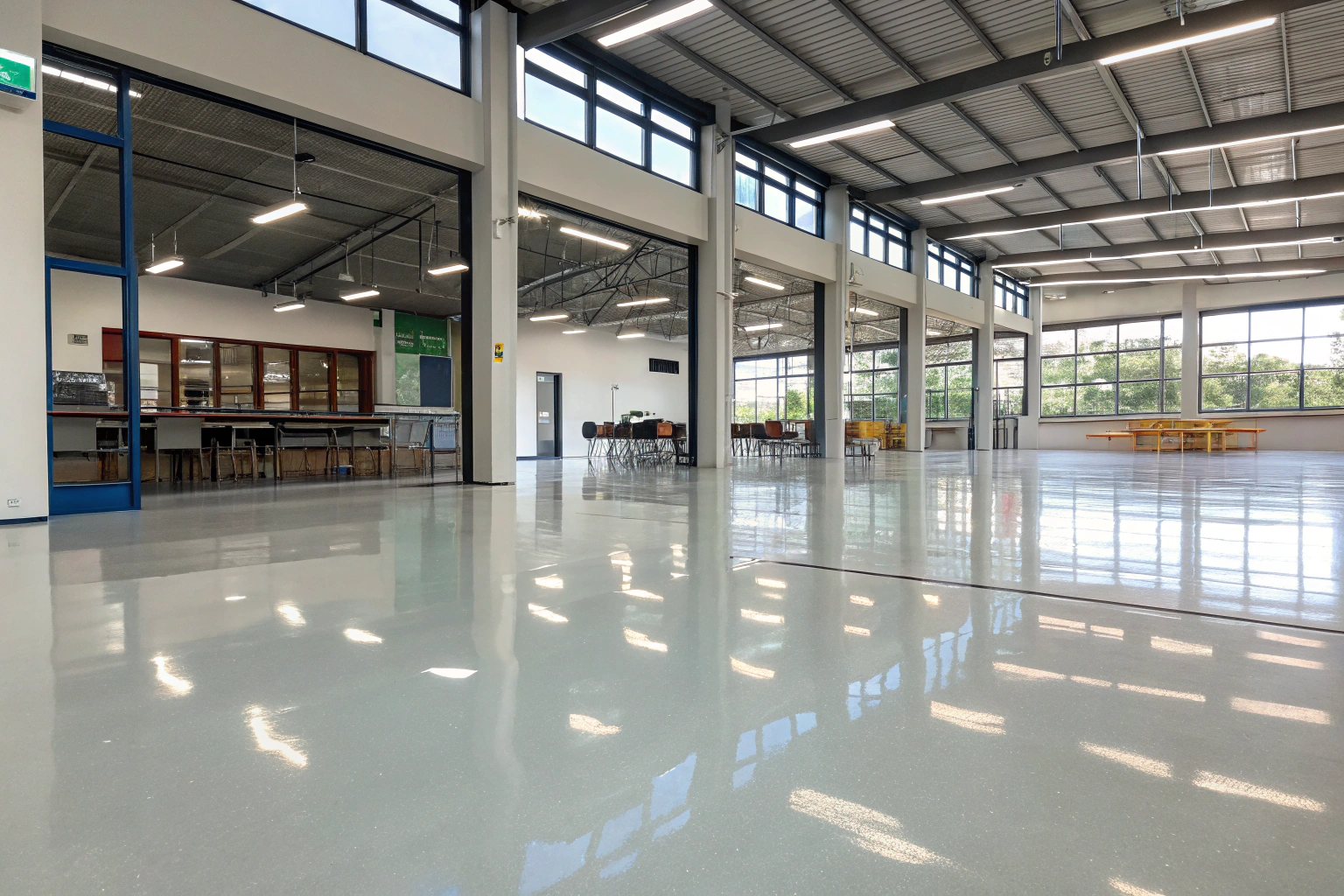
Why Educational Facilities Demand a Different Flooring Standard
Educational environments are not like any other commercial space. A retail floor handles foot traffic. An office floor handles foot traffic. A school floor handles foot traffic, chemical spills, furniture impact, wet shoes, food contamination, aggressive cleaning schedules, and the physical chaos of hundreds of children — every single day, for decades.
The consequences of a flooring failure in a school aren’t just cosmetic. A surface that degrades, lifts, or loses its slip resistance becomes a safety incident. In a childcare centre or primary school, that’s a child. In a TAFE workshop or university laboratory, that’s a staff member or student with a WorkSafe claim attached. Facilities managers carry that liability personally, and the flooring system they specify is part of how they manage it.
Budget and operational constraints make the decision harder, not easier. Public and institutional funds are scrutinised. Closures cost money and disrupt learning. A flooring system that fails in three years and needs replacement isn’t a saving — it’s a compounding cost. Getting the specification right the first time is the only approach that makes sense.

Performance Requirements Epoxy Flooring Meets in School Environments
Extreme foot traffic durability. Hundreds of students cycle through the same corridors and classrooms daily. A properly specified epoxy system handles that volume without surface degradation — year after year, not just for the first inspection cycle. Impact and abrasion resistance. Chairs are dragged across floors dozens of times a day. Desks shifted, equipment dropped, trolleys rolled. Epoxy handles the physical demands of active young users without chipping, cracking, or wearing through.
Slip resistance. Anti-slip aggregate systems meet AS 4586 requirements across wet and dry areas — bathrooms, canteens, science labs, and corridors where wet shoes are a daily reality. Chemical and stain resistance. Laboratory reagents, commercial cleaning agents, art materials, food and beverage spills. The surface handles all of it without staining, softening, or breaking down.
Hygienic seamless finish. Non-porous epoxy eliminates the grout lines and surface gaps where bacteria and allergens accumulate — a meaningful health advantage in environments responsible for children and staff. Low-VOC fast-cure systems. Spaces return to use quickly, without lingering chemical odour when students come back.
Spaces Within Educational Facilities Where Epoxy Is Specified
Epoxy flooring isn’t a single product applied the same way across every room. Different spaces within an educational facility carry completely different performance demands — a science laboratory has nothing in common with a gymnasium, and a childcare centre playroom has nothing in common with a TAFE workshop. A contractor who specs the same system across every space isn’t doing their job. The right approach is a room-by-room assessment that matches the correct epoxy system to each environment — accounting for slip resistance requirements, chemical exposure, foot traffic volume, hygiene obligations, and return-to-use timelines. That’s how we work across Hobart’s schools, universities, TAFEs, and early childhood centres. Here’s where epoxy systems are most commonly installed.
☑ Corridors and common areas — maximum durability and easy cleaning for the highest foot traffic zones in the building
☑ Classrooms and learning spaces — durable, low-maintenance surfaces that handle daily furniture movement and cleaning schedules
☑ Science and technology laboratories — chemical-resistant systems meeting safety requirements for laboratory environments
☑ Canteens and food preparation areas — food-safe, slip-resistant systems meeting commercial kitchen hygiene standards
☑ Gymnasiums and sports halls — impact-resistant systems with appropriate surface profiles for physical activity
☑ Amenities and bathroom areas — wet-area rated slip-resistant systems with coved skirting for hygiene compliance
☑ Workshop and trade training areas — heavy-duty industrial-grade systems for TAFE and vocational training facilities
☑ Early childhood centres — low-VOC, non-toxic systems safe for young children, available in bright colour options that support learning environments
Colour, Branding, and Design Flexibility in Educational Epoxy Flooring
Most facilities managers don’t put aesthetics at the top of their specification brief — safety, durability, and compliance come first. But once those boxes are ticked, the design capability of a well-specified epoxy system becomes a genuine asset that institutional clients don’t fully anticipate until they see it in practice.
Epoxy is available across a wide range of colours and finishes. More practically, colour can do real work in an educational facility. Zone demarcation between learning areas, wayfinding through corridors, and hazard identification in laboratories and workshops can all be integrated directly into the floor during installation — not a decal or painted line that peels off in twelve months, but part of the system itself.
School branding colours can be incorporated into common areas, gymnasiums, and entry corridors. Early childhood centres benefit from bright, stimulating options that make the space feel purposefully designed for young children. Specified correctly from the outset, it adds minimal cost and produces a result that looks deliberately considered.
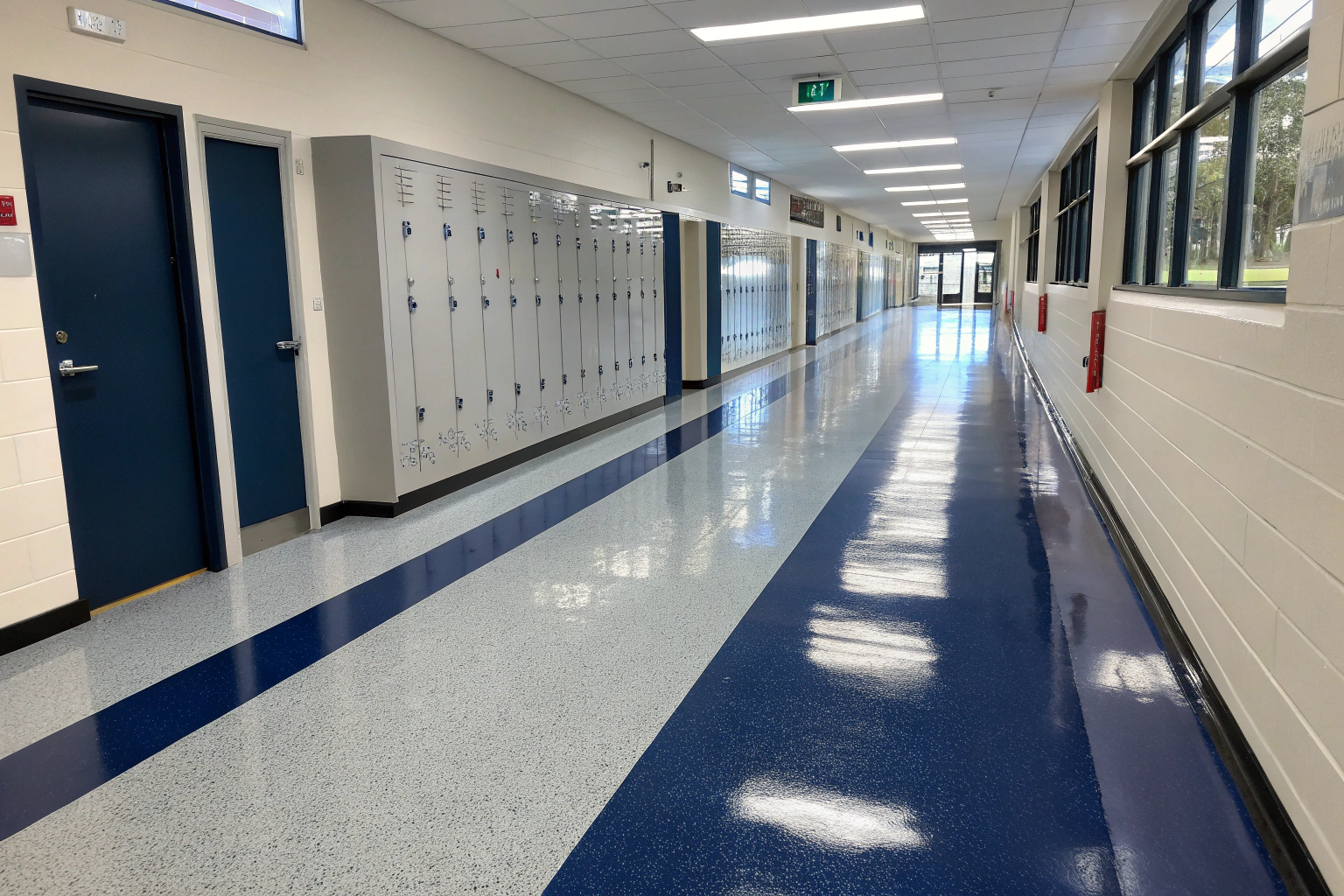
How We Assess and Specify Flooring for Educational Facilities
Getting the specification right for an educational facility starts with understanding what’s already there. Every assessment begins with a site visit — not a phone quote, not an estimate based on square meterage alone.
On-site, we assess the current condition of the concrete substrate, test for moisture vapour transmission, identify existing damage, including cracking, contamination, and previous coating failures, and map the specific performance requirements of each space within the facility.
From that assessment, we produce a room-by-room specification that covers:
- System selection — the correct epoxy product for each space based on traffic, chemical exposure, and hygiene requirements
- Surface preparation method — diamond grinding, shot blasting, or crack repair as required by the substrate condition
- Slip resistance classification — AS 4586 ratings confirmed for each wet and dry area
- Installation scheduling — mapped to the academic calendar with return-to-use dates confirmed before work begins
- VOC and cure time considerations — fast-cure and low-odour systems identified where needed
That document becomes the basis for a fixed-price quote — no variables, no surprises when the invoice arrives. For facilities managers working within capital works budgets and reporting to school boards or institutional procurement processes, that transparency is part of how we work, not an exception to it.
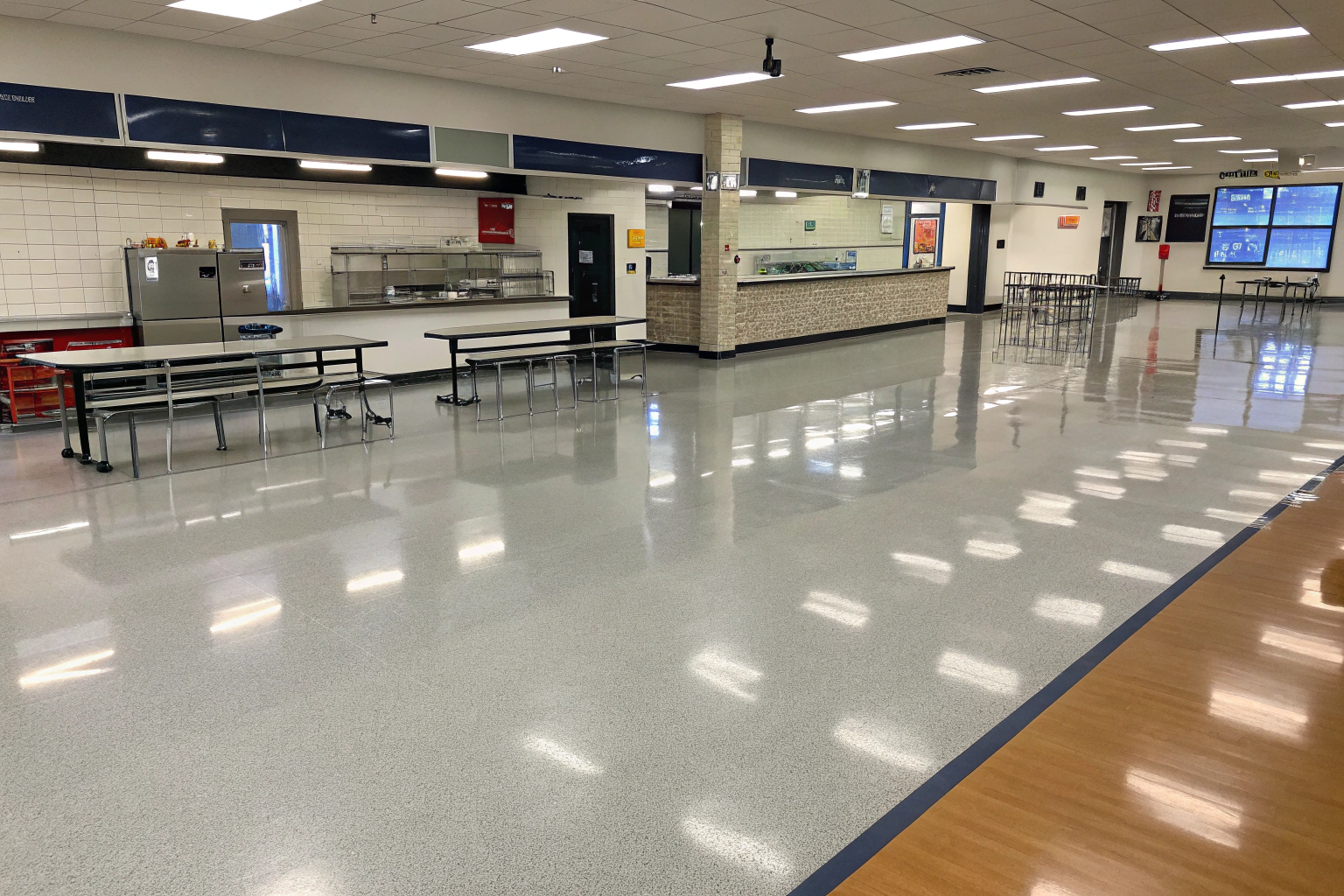
How Epoxy Flooring Holds Up Under Heavy Educational Foot Traffic
A school corridor during changeover is one of the most punishing flooring environments that exists. Hundreds of students moving in concentrated bursts, multiple times a day, five days a week, forty weeks a year. Most flooring systems aren’t built for that volume — they’re built for general commercial use, which is a different thing entirely.
Epoxy flooring specified for educational environments is formulated to handle that load without surface degradation. The hardness and density of a commercial-grade epoxy system resist the abrasion that breaks down softer surfaces over time. There’s no lifting, no delamination, no worn tracks appearing through high-traffic lines. The surface that’s there on day one is functionally the same surface that’s there ten years later — provided the preparation was done correctly, and the right system was specified for the traffic volume.
For Hobart schools managing ageing infrastructure on tight capital budgets, that longevity isn’t a luxury. It’s the entire point of the investment.
Epoxy Flooring Maintenance in Schools — What Facilities Managers Need to Know
One of the practical advantages of epoxy flooring that doesn’t always make it into the specification brief is how little maintenance it actually requires once it’s installed. For facilities managers juggling cleaning schedules, contractor rosters, and tight operational budgets, that matters.
A properly installed epoxy surface is maintained with standard commercial cleaning equipment. Autoscrubbers, mop systems, and pH-neutral cleaning agents are all compatible — there’s no specialist product required and no fragile surface finish to protect. The seamless non-porous finish means spills sit on the surface rather than penetrating it, so cleaning is faster and more effective than grout-lined or textured alternatives.
Periodic inspection is straightforward. The surface either looks right or it doesn’t — there’s no ambiguity about wear. In high-traffic zones like corridors and canteens, a maintenance coat can extend the life of the system significantly without requiring full removal and recoat. For Hobart schools managing cleaning staff and janitorial budgets, a floor that cleans quickly, dries fast, and doesn’t require specialist treatment is a genuine operational advantage.
Minimising Disruption to Learning Environments During Installation
The single biggest practical concern for any facilities manager commissioning floor works in an educational setting isn’t the product — it’s the timing. Schools and universities run on fixed academic calendars. There is no flexibility in that. Students arrive on a date, and the floor has to be ready before they do.
We plan and schedule every educational installation around those windows. School holiday periods, semester breaks, and summer closures are the primary installation windows — and we mobilise specifically for them. That means quotes are turned around quickly, materials are ordered ahead of the break, and crews are on site from day one of the available window rather than day five.
Fast-cure epoxy systems are used where return-to-use deadlines are tight. Spaces that need to be operational within 24 to 48 hours of completion can be accommodated with the right system specification. Low-VOC formulations mean there’s no lingering chemical odour when staff and students return. The job is done, the space is clear, and the floor is ready — before the bell rings.
Frequently Asked Questions — Educational Institution Epoxy Flooring Hobart
Yes — we schedule all educational installations around the academic calendar. Holiday periods, semester breaks, and summer closures are our primary windows and we plan specifically for them.
Low-VOC, non-toxic systems are available specifically for early childhood environments. These meet the Education and Care Services National Regulations for premises standards.
Yes. Anti-slip aggregate systems are specified to meet AS 4586 requirements for wet areas, including bathrooms, canteens, and science laboratories.
No — and it shouldn’t be. Different spaces have different requirements. We produce a room-by-room specification for every facility we assess.
We assess the substrate on site and determine the correct preparation method — diamond grinding, shot blasting, or crack repair — based on the actual condition of the concrete.
Get a Facilities Assessment and Specification Quote
If the flooring in your school, university, TAFE, or childcare centre is overdue for an upgrade — or if you’re planning for the next holiday period works window — the right time to get a specification assessment done is before the pressure is on.
We work with facilities managers and school business managers across greater Hobart, the Huon Valley, Derwent Valley, and regional Tasmanian campuses. The assessment is structured, the quote is fixed-price, and the scheduling is built around your academic calendar from the start.
Call us or submit an enquiry today to book your facilities assessment. We’ll assess your current floor condition, identify any compliance gaps, and specify the right system for every space in your facility.
