
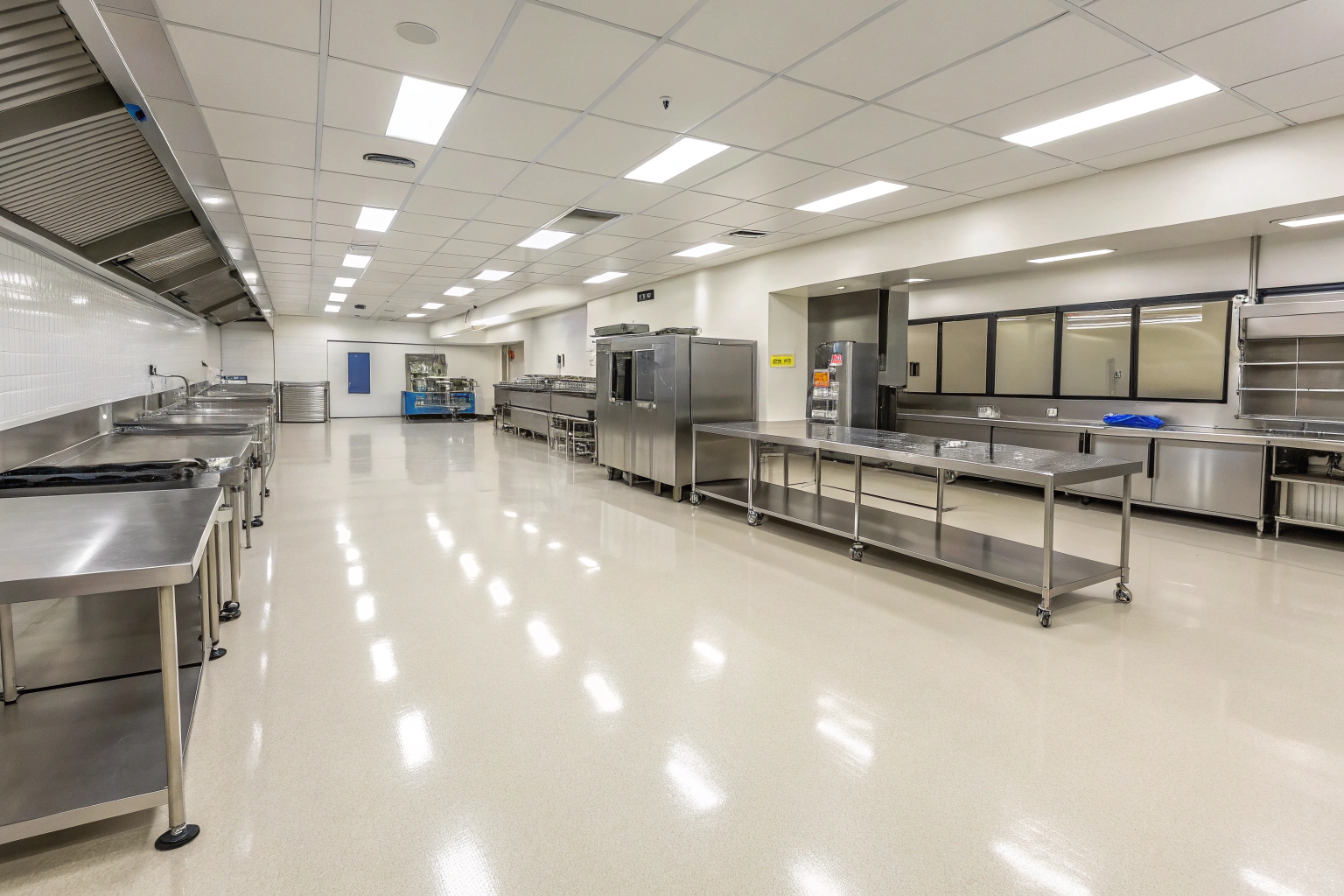
The Hygiene Case for Seamless Epoxy Flooring in Food Premises
Every surface in a commercial kitchen carries a hygiene responsibility — and the floor carries one of the highest. It’s exposed to food spills, grease, hot water washdowns, chemical sanitisers, and constant foot traffic across every single service. What that surface is made of, and how it’s installed, directly affects how effectively it can be cleaned and how well it holds up to a food safety audit.
Traditional tiled floors have grout lines. Grout lines harbour bacteria, absorb moisture, and resist the kind of deep cleaning a commercial kitchen demands. Sealed concrete has surface pores. Even well-maintained vinyl can lift at joins and create gaps where contamination builds.
Epoxy is different. A correctly installed epoxy system creates a single continuous surface — no joins, no grout lines, no pores. Cleaning chemicals reach every part of it. Hot water washdowns don’t compromise it. And food safety inspectors can see immediately that the surface meets the impervious, easy-to-clean standard the Australia New Zealand Food Standards Code requires.

How Epoxy Systems Meet Commercial Kitchen Performance Requirements
A commercial kitchen puts a floor through more daily stress than almost any other environment — heat, chemicals, heavy equipment, constant movement, and repeated deep cleaning. Epoxy systems are specifically engineered to handle all of it. Unlike standard flooring products, a commercial-grade epoxy system is specified to meet the exact performance requirements of a food service environment — not adapted from a residential product, not a DIY kit from a hardware store. Every aspect of how it performs has a direct connection to hygiene, safety, and long-term compliance. Here’s what that looks like in practice:
- ✅ Seamless and Non-Porous Surface
- ✅ Chemical and Grease Resistance
- ✅ Thermal Shock and Steam Resistance
- ✅ Slip Resistance Ratings for Wet Kitchen Environments
- ✅ Coved Skirting Integration
- ✅ Impact, Abrasion, and Heavy Traffic Resistance
- ✅ Drainage Compatibility and Fall Gradients
Commercial Kitchen Epoxy Finishes Built for Hobart Hospitality
A compliant floor doesn’t have to be a purely functional one. Commercial kitchen epoxy systems are available in a range of finishes — from clean, light-reflective solids that brighten a working kitchen to slip-rated surfaces with subtle aggregate texture that maintains a professional appearance without compromising safety ratings.
For Hobart’s hospitality operators, presentation matters beyond the dining room. Open kitchens, pass-through windows, and food production facilities that receive clients or undergo regular inspections benefit from a floor that looks deliberately finished — not just poured and forgotten. A well-specified epoxy finish signals to inspectors, staff, and visitors alike that the operation is run to a high standard.
Light-toned finishes also have a practical hygiene benefit — they make spills, residue, and cleaning gaps immediately visible, which supports faster response during service and more thorough cleaning at close. A floor that looks right and performs right is always the better investment.
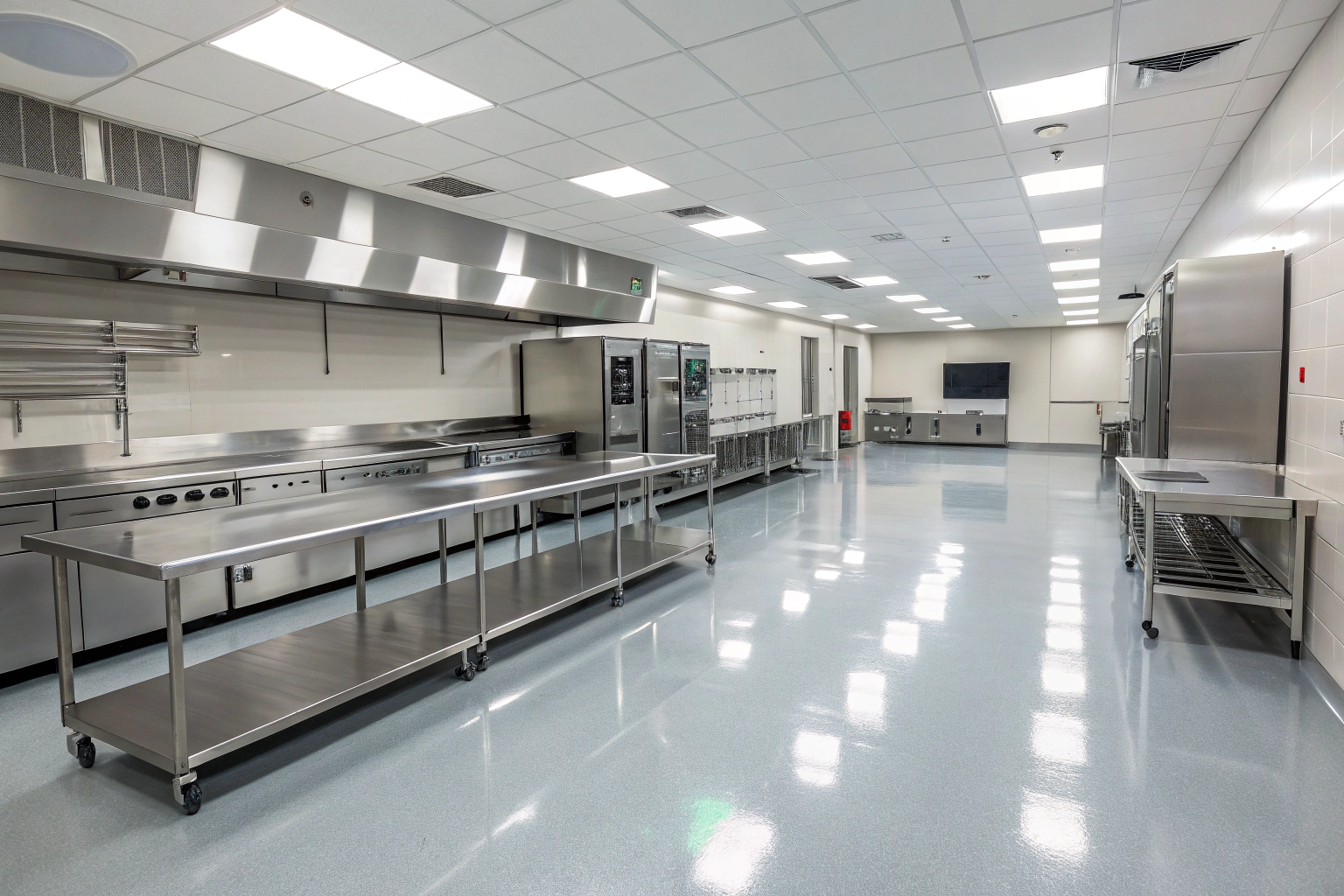
Australian Food Safety Standards and What They Mean for Your Floor
The Australia New Zealand Food Standards Code sets out clear requirements for food premises floors — and they’re not open to interpretation. Floors in food preparation areas must be smooth, impervious to moisture, free from cracks and crevices, and easy to clean and sanitise. That’s not a recommendation. It’s a compliance requirement that council inspectors and food safety auditors assess against every time they walk through your kitchen.
What that means practically is that a floor with grout lines, surface pores, lifting joints, or areas that retain moisture after cleaning doesn’t meet the standard — regardless of how well the rest of the kitchen is maintained. The floor is assessed on its own merits as a hygiene-critical surface.
A correctly specified and installed commercial epoxy system meets every one of these requirements by design. The surface is seamless and impervious. It cleans to a food-safe standard with standard commercial sanitisers. It doesn’t harbour moisture or bacteria between services.
Clear Cut Epoxy Flooring installs systems to these specifications and can provide documentation of the installed system to support your compliance audits and council inspections.
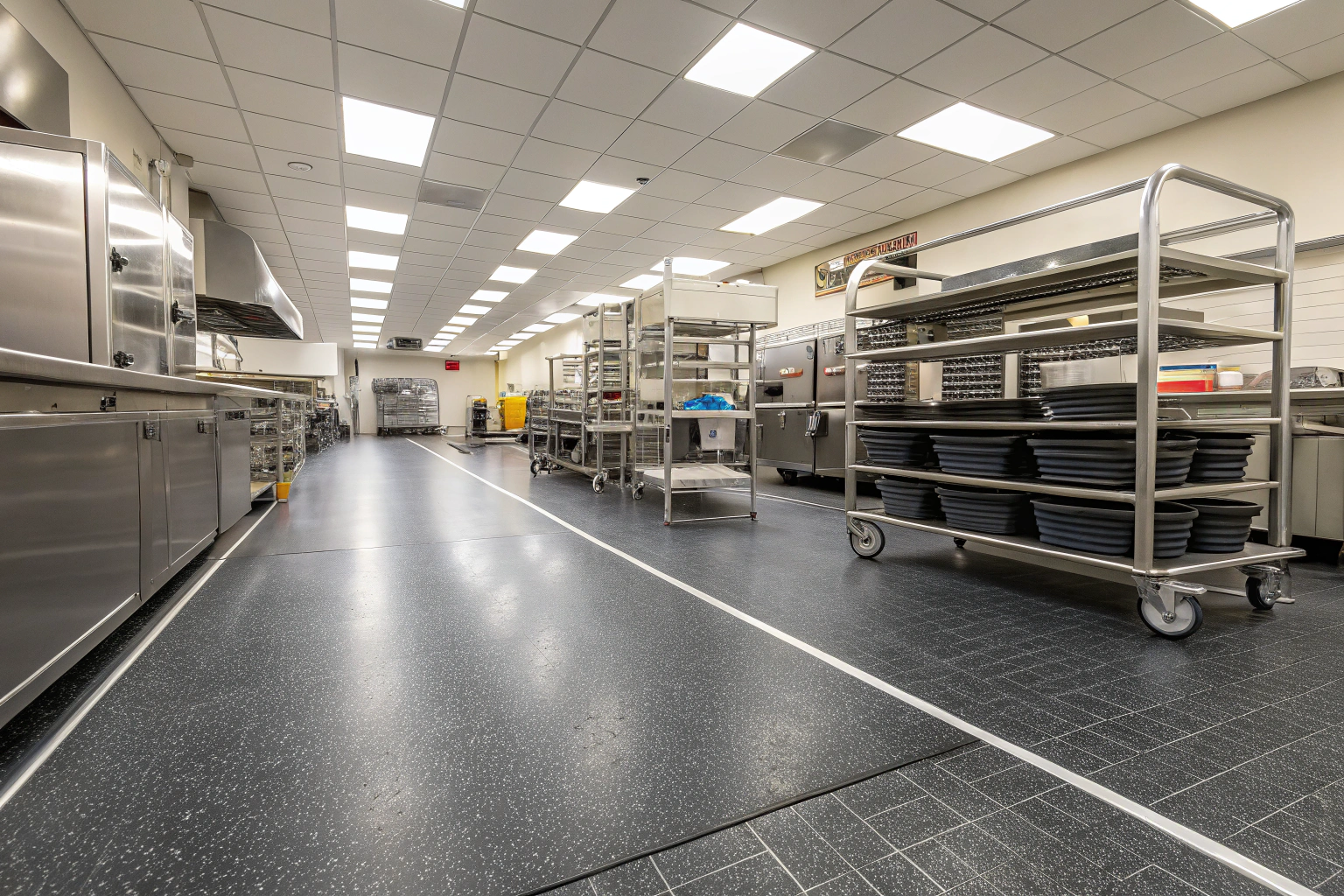
Epoxy Kitchen Floors Built to Handle the Heaviest Commercial Traffic
A busy commercial kitchen doesn’t slow down — and neither does the wear on the floor. Trolleys loaded with produce, heavy equipment being moved during service, constant foot traffic from a full kitchen brigade, and the repeated impact of dropped utensils and cookware all add up to a level of mechanical stress that standard flooring simply isn’t rated for.
Commercial-grade epoxy systems are specified with compressive and impact resistance that handle this daily punishment without surface degradation. The coating doesn’t chip, crack, or delaminate under load — which matters both for longevity and for hygiene, because a damaged surface creates exactly the kind of cracks and crevices the Food Standards Code requires you to eliminate.
For kitchens running high trolley traffic or heavy equipment, broadcast aggregate systems add a layer of surface hardness while simultaneously achieving the slip resistance ratings required for wet commercial environments. The floor performs harder because it’s built to.
Surface and Joint Repairs We Complete Before Coating
A commercial kitchen epoxy floor is only as good as the substrate it’s bonded to. Before any coating goes down, the existing concrete surface needs to be assessed, prepared, and repaired to a standard that gives the epoxy system a clean, stable base to bond to. That preparation work is what separates a floor that lasts a decade from one that starts showing problems within a year.
Cracks, control joints, and damaged sections are repaired before the coating process begins. Crack injection, joint filling, and surface patching using appropriate repair mortars bring the substrate back to a condition that won’t telegraph through the finished coating or create hygiene gaps in the final surface. Any contamination from oils, grease, or previous coatings is mechanically removed through diamond grinding.
The result is a substrate that’s clean, level, and properly profiled for maximum epoxy adhesion. In a commercial kitchen environment, this preparation work isn’t optional — it’s what the Food Standards Code’s requirement for a smooth, impervious, crack-free surface is built on. Clear Cut Epoxy Flooring completes all surface preparation in-house before any coating is applied.
Cold Storage and Food Processing Floor Solutions in Hobart
Cold storage and food processing environments place demands on a floor that go beyond a standard commercial kitchen. Temperature fluctuations between cold rooms and ambient spaces create expansion and contraction cycles that standard coatings can’t handle — leading to delamination, cracking, and surface failure that creates both a hygiene liability and a maintenance headache.
Epoxy systems specified for cold storage and food processing environments are formulated to handle these thermal cycling conditions. Low-temperature cure systems and flexible epoxy formulations maintain adhesion and surface integrity across the temperature ranges common in Hobart’s food processing and cold storage operations — from ambient production areas through to chilled and frozen storage spaces.
For food processing facilities, chemical resistance is equally critical. Floors in these environments are exposed to food acids, sanitisers, and cleaning agents at higher concentrations and frequencies than a standard kitchen. The right epoxy system handles all of it without surface degradation.
Clear Cut Epoxy Flooring works with food processing and cold storage operators across greater Hobart and southern Tasmania to specify the right system for the right environment.
Frequently Asked Questions About Commercial Kitchen Epoxy Floors in Hobart
Yes. A correctly specified and installed commercial epoxy system meets the Australia New Zealand Food Standards Code requirements for food premises floors — smooth, impervious, and easy to clean and sanitise.
Commercial kitchen epoxy systems with anti-slip aggregate broadcast achieve P4 and P5 wet area ratings under AS 4586 — the classifications required for wet commercial kitchen environments under Australian standards.
A correctly prepared and installed commercial kitchen epoxy floor typically lasts 10 to 15 years under normal food service conditions. Surface preparation quality and product specification are the two biggest factors in longevity.
Yes. Low-temperature cure and flexible epoxy formulations are available specifically for cold storage environments — handling the thermal cycling between chilled and ambient spaces without adhesion failure or surface cracking.
Yes. Commercial-grade epoxy systems are formulated for thermal shock resistance — they handle hot water washdowns, steam cleaning, and temperature fluctuations without cracking, blistering, or delaminating from the substrate.
Book a Compliance Floor Assessment for Your Hobart Kitchen
If your kitchen floor is coming up for a council inspection, you’re planning a fit-out, or you’re simply ready to bring your food premises up to the standard it should be at, start with a site assessment. Clear Cut Epoxy Flooring assesses your existing floor against current food safety requirements, identifies what preparation work is needed, and specifies the right epoxy system for your environment and trading conditions.
We work with restaurants, cafés, catering facilities, food production operations, and institutional kitchens right across greater Hobart and southern Tasmania. Get a clear picture of what your floor needs and what it’ll cost — no obligation, no pressure. Call us today for your free quote.
